
How Can a Genogram Help You Understand Family Patterns?
A genogram helps you understand family patterns by visually mapping relationships, behaviors, life events, and emotional dynamics across multiple generations. Unlike a basic family tree, a genogram reveals recurring patterns such as communication styles, conflict, trauma, addiction, mental health concerns, and relationship strengths, helping individuals gain insight into how their family history influences their present life.
At Strengthened Heart Counseling, we believe meaningful change begins with understanding your story. Many people come to counseling because they feel stuck in recurring relationship conflicts, anxiety, depression, or unhealthy patterns without realizing those experiences may have deep family roots. A genogram provides a compassionate, structured way to explore those influences without assigning blame. Instead of focusing only on current struggles, we help individuals, couples, and families discover how generational experiences have shaped beliefs, coping strategies, and relationships. This greater awareness often becomes the foundation for healthier choices, stronger relationships, and lasting emotional healing.
Understanding Family Patterns Through a Genogram
A genogram is a therapeutic tool that provides a visual map of family relationships and patterns across three or more generations.
Originally developed within Bowen Family Systems Theory, a genogram goes far beyond names and birth dates. It helps therapists and clients identify emotional connections, recurring behaviors, significant life events, health histories, and family roles that often repeat from one generation to the next. According to the National Center for Biotechnology Information (NCBI), genograms serve as both an assessment tool and a therapeutic intervention because they help clients recognize intergenerational patterns while encouraging healthier ways of relating.
Unlike a traditional family tree, a genogram may include:
- Marriages, divorces, and remarriages
- Close, distant, or conflicted relationships
- Mental health history
- Addiction or substance use
- Significant losses and trauma
- Medical conditions
- Family roles
- Communication styles
- Cultural or religious influences
Seeing these patterns visually often helps clients connect pieces of their story that previously felt unrelated.
Example: What Does a Genogram Look Like?
Sometimes it’s easier to understand a genogram by seeing how it applies to a real-life situation.
Imagine a client named Sarah who begins counseling because she struggles with anxiety, has difficulty setting boundaries, and often feels responsible for everyone else’s happiness. She wonders why these patterns seem so automatic.
As Sarah and her therapist begin creating a three-generation genogram, several important family themes emerge.
Generation One: Grandparents
Sarah learns that her grandfather struggled with alcohol use throughout much of his life. Her grandmother coped by avoiding conflict and keeping peace in the household at all costs. Difficult emotions were rarely discussed openly.
Generation Two: Parents
Sarah’s father also struggled with alcohol misuse and tended to withdraw emotionally during conflict. Her mother became the caretaker of the family, often putting everyone else’s needs before her own. Arguments occurred regularly, but honest conversations about feelings almost never happened.
Generation Three: Sarah
Without realizing it, Sarah developed many of the same coping strategies she observed growing up.
Today she notices that she:
- Avoids conflict whenever possible.
- Has difficulty saying no.
- Feels responsible for other people’s emotions.
- Experiences anxiety in close relationships.
- Struggles to ask for help.
Instead of viewing these behaviors as personal flaws, Sarah begins to recognize that they were learned adaptations within her family system. This insight becomes incredibly freeing because it reminds her that learned patterns can also be changed.
Below is a simplified example of what a genogram might look like.
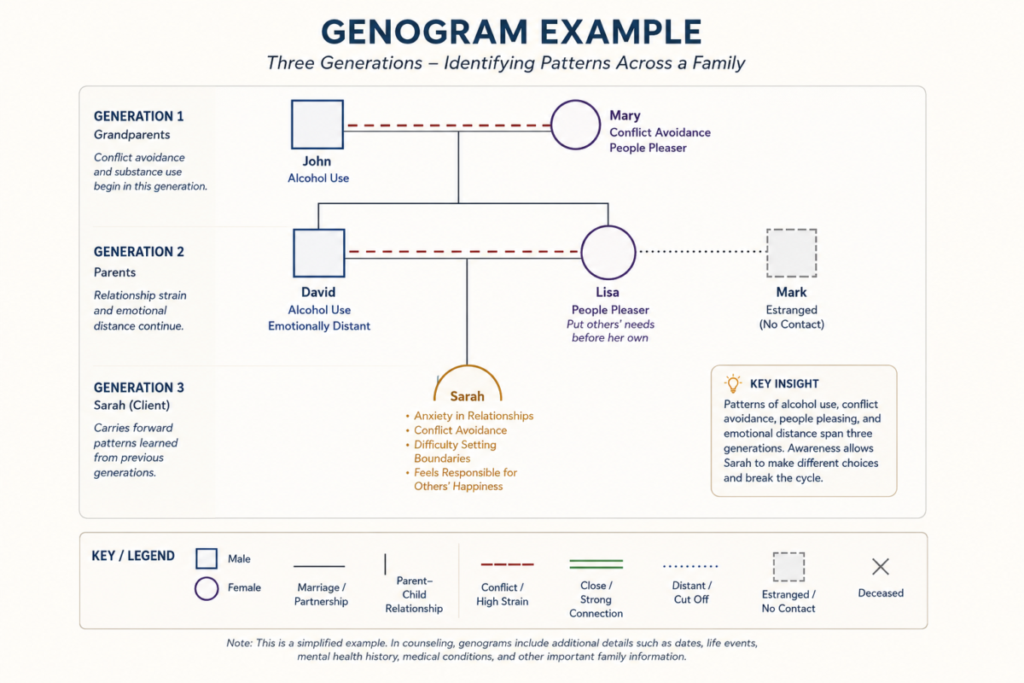
Caption: This simplified genogram illustrates how behaviors like conflict avoidance, substance use, emotional distance, and people pleasing can repeat across generations. In counseling, therapists use standardized symbols and relationship lines to map many additional family dynamics.
This visual often becomes a turning point for clients. Instead of asking, “What’s wrong with me?” they begin asking, “What have I learned, and what would I like to do differently?”
How Does a Genogram Reveal Generational Patterns?
A genogram makes recurring family dynamics easier to recognize because it places multiple generations into one visual framework.
Many people discover repeating themes such as:
- Anxiety
- Depression
- Addiction
- Conflict avoidance
- Perfectionism
- Emotional distance
- Caregiving roles
- Divorce or relationship instability
Recognizing these patterns is not about predicting your future or blaming previous generations. Rather, it creates awareness, which is the first step toward change.
For many clients, simply seeing these themes mapped visually helps them understand why certain responses feel so automatic.
Can a Genogram Improve Relationships?
Yes. A genogram often helps individuals and couples better understand why relationship challenges continue to repeat.
Many of our expectations around communication, conflict, affection, boundaries, and trust are learned long before adulthood. When couples explore each partner’s family history, they often discover that they learned very different ways of expressing emotions and handling stress.
A genogram can help couples identify:
- Communication styles
- Attachment patterns
- Family expectations about marriage
- Conflict resolution habits
- Emotional triggers
- Family loyalties
- Healthy and unhealthy boundaries
Instead of viewing a partner’s behavior as simply frustrating, couples begin to understand where those behaviors developed. That understanding often creates greater empathy and more productive conversations.
Research on Bowen Family Systems Theory continues to support the value of understanding multigenerational influences when helping families improve communication and relationships.
What Happens During a Genogram Session?
Creating a genogram is a collaborative process between you and your therapist.
You do not need perfect knowledge of your family history. Together, you simply gather the information that is available and meaningful.
A typical session includes:
- Identifying immediate and extended family members.
- Discussing important life events and relationships.
- Mapping emotional connections.
- Identifying recurring themes or patterns.
- Exploring how those patterns influence your current experiences.
- Identifying strengths and resilience that have also been passed through your family.
The goal is never to criticize family members or assign blame. Instead, the process encourages curiosity, understanding, and compassion while helping you recognize both the challenges and strengths that have shaped your family story.
What Are the Benefits of Using a Genogram in Therapy?
The greatest benefit of a genogram is increased self-awareness.
Clients frequently leave with a clearer understanding of why certain thoughts, emotions, or relationship patterns feel so familiar.
Benefits include:
- Greater emotional insight
- Improved communication
- Healthier boundaries
- Increased empathy toward family members
- Better understanding of trauma and resilience
- Identification of personal strengths
- Breaking unhealthy generational cycles
- Building healthier relationships
Recent counseling literature also notes that genograms help clients anticipate challenges, recognize family strengths, and develop healthier responses by understanding their family history within a broader life context.
Frequently Asked Questions
Is a genogram the same as a family tree?
No. A family tree records genealogy, while a genogram also maps emotional relationships, communication patterns, health history, significant life events, and recurring family dynamics.
How many generations should a genogram include?
Most therapists include at least three generations because recurring patterns become easier to recognize across grandparents, parents, and children.
Do I need to know everything about my family history?
No. Therapists work with whatever information is available. Even incomplete genograms can provide meaningful insight and support personal growth.
Can I complete a genogram if my family members are not in counseling?
Absolutely. Genograms are commonly used in individual counseling. You do not need other family members to participate in order to benefit from exploring your own family history.
Discover Your Story, Change Your Future
Understanding where your patterns began can be one of the most empowering steps in counseling. A genogram is much more than a family diagram. It is a roadmap that helps you recognize inherited strengths, identify recurring challenges, and make intentional choices for your future.
At Strengthened Heart Counseling, we use evidence-based approaches like genograms to help individuals, couples, and families gain deeper self-awareness and build healthier relationships. We believe your past helps explain your story, but it does not have to define your future.
Ready to better understand your story and begin creating lasting change? Contact us to schedule an appointment today.